Wildebeest Migration in Serengeti | Best Time & Migration Map 2027
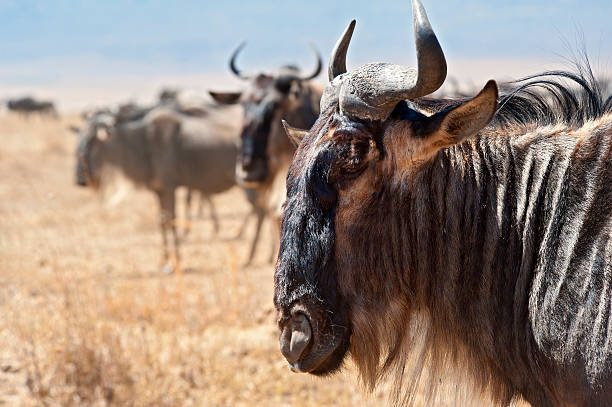
The Wildebeest Migration Serengeti Safari Overview
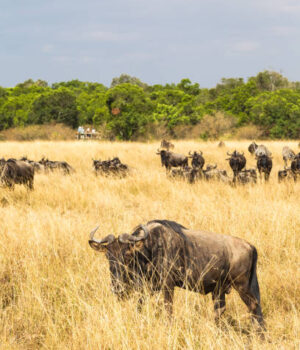
The Wildebeest Migration of the Serengeti is one of Africa’s most fabulous tourist attractions and is recognized as one of the Seven Natural Wonders of the World. Every year, about 1.5 million wildebeest accompanied by more than 250,000 zebras and gazelles, make their way across the vast Serengeti-Mara ecosystem in search of some decent grazing and a drink of water. Those wildebeests in Africa migrating from Serengeti National Park to Masai Mara are actually following the rainfall or more to the point of the lack of it, so the exact spot and timing of the herd can easily vary from year to year. It’s worth noting that the Serengeti migration safari is not a one-off experience that materializes in a single month.
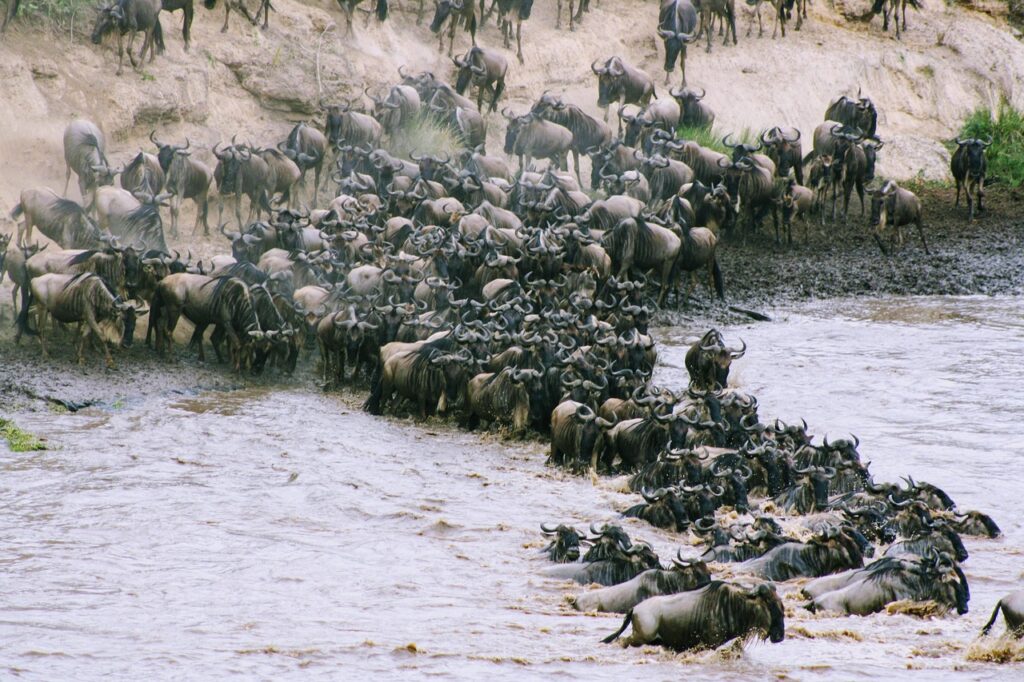
So, it’s actually a yearly loop that takes visitors on a fantastic journey through various parts of the Serengeti. From December through to March, big wildebeest herds amass on the southern plains of Serengeti around the Ndutu Region to take advantage of the calving season. As the grazing gets better or worse, the animals generally migrate through the central and western parts of the Serengeti till they get to the northern Serengeti where the Mara River can bring about some of the most spectacular river crossing views.
The best time in Africa to see wildebeests during a Serengeti migration safari is really down to what you want to see. If it’s newborn calves and predator action you want to see, then head to the southern plains. If the Western Corridor and the Grumeti River along with the herds on the move, sound like your thing, that might be the place to go. Or if it’s the Mara River crossings you are after, then the Northern Serengeti is the place to be. In this guide by the Serengeti Masai Mara Experts, discover where the wildebeests are in Serengeti each month and the top spots to see the great migration in Africa. Also, when you should go, how Grumeti and Mara river crossings work, where to stay and how to pick the right Serengeti migration safari in Tanzania for you.
The Wildebeest Migration Serengeti Safari at a Glance
| Question | Quick Answer |
|---|---|
| Where does the migration happen? | Serengeti-Mara ecosystem in Tanzania and Kenya |
| Does the great migration in Africa occur all year? | Yes |
| Best time for calving season in Serengeti? | Generally January-March |
| Best time for moving herds? | Usually May-June |
| Best time for Grumeti crossings? | Generally May-July |
| Best time for Mara River crossings in Tanzania? | Generally July-October |
| Where are the herds in February? | Southern Serengeti and Ndutu |
| Where are the herds in June? | Central and Western Serengeti |
| Where are the herds in August? | Northern Serengeti and the Mara ecosystem |
| Are wildebeest river crossings in Serengeti guaranteed? | No |
Key Facts and Figures About the Wildebeest Migration in the Serengeti
| Fact | Figure / Detail |
|---|---|
| Main migrating wildebeest population from Serengeti NP | About 1.3-1.5 million |
| Main wildebeest species | Western white-bearded wildebeest (Connochaetes taurinus mearnsi) |
| Zebra moving with the herds | More than 250,000 |
| Total migrating animals | More than 1.5 million, with some TANAPA material citing around 1.6 million wildebeest and zebra |
| Annual migration distance | Roughly 800-1,000 km, depending on how the route is measured |
| Ecosystem | Serengeti-Mara ecosystem |
| Main countries | Tanzania and Kenya |
| Calving season | Mainly January-March |
| Peak calving period | Usually around February |
| Calves born annually | More than 250,000 in TANAPA’s migration facts |
| Births during peak calving in the Serengeti Region | About 8,000-12,000 births per day |
| Main calving area | Southern Serengeti and Ndutu plains |
| Grumeti movement | Generally May-June |
| Northern movement | Mainly June-July |
| Mara River phase | Generally July-October |
| Return toward southern Serengeti | Mainly November-December |
| Grass consumed | TANAPA estimates about 4,800 tonnes per day by approximately 1.35 million wildebeest |
| Dung deposited | About 3,500 tonnes per day according to TANAPA’s migration facts |
The exact population figures for animals that migrate from Serengeti National Park vary between sources and survey methods. Scientific research has estimated the migratory wildebeest population at approximately 1.3 million, while TANAPA publications commonly describe the population as about 1.35-1.5 million.
Why Do Wildebeests in Serengeti Migrate?
The wildebeest migration in Serengeti is ultimately all about the weather and the availability of tasty grass. They dont really keep to a schedule though it’s more about following the rainfall and where the fresh grass is. Those wildebeest move across the Serengeti-Mara ecosystem to keep an eye out for the best grazing and water sources and avoid getting stuck in a parched wasteland without a drop to drink or a blade of grass to munch on. When it rains in Serengeti, the southern sections and Ndutu plains are goldmines for nourishing grass. The wildebeest gather here to raise their young because the calves run and eat freely and adults can refuel.
As dry season arrives, grass withers, water sources dry up, and hungry wildebeest take over hence head off west and north to find greener pastures and more reliable waterholes. This new grass gives wildebeests all the nourishment they need to recharge and reproduce. Some travellers have observed the wildebeest migration in Serengeti and found that rainfall patterns are closely linked to grass kind. That’s why the migration takes us through the Southern, Central, Western, and Northern Serengeti before some wildebeest reach Kenya’s Masai Mara.
And once the rains roll back into the south and the grass starts growing again, the whole cycle starts over. Lastly, predators, including lions, hyenas, cheetahs and crocodiles are an important part of the ecosystem, but avoiding predators is not the main reason for the migration in Serengeti. The primary drivers are rainfall, fresh grazing and water availability. Because rainfall patterns change from year to year, the exact timing and location of wildebeests also changes. For visitors planning a Wildebeest Migration Serengeti safari, choosing the right region for their travel dates is therefore more important than relying on fixed migration dates.
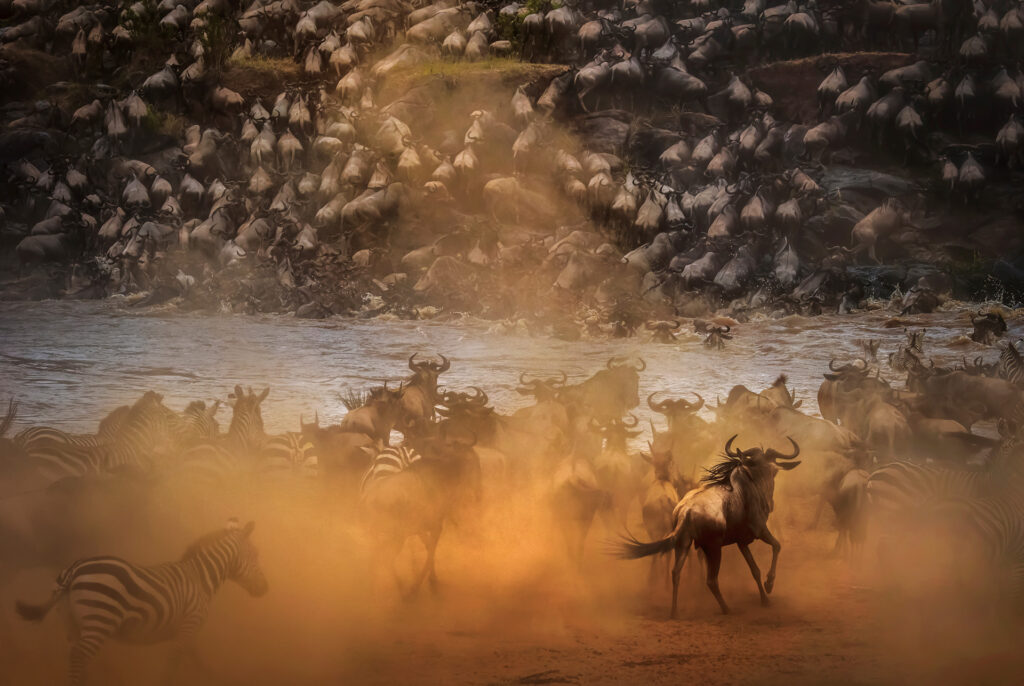
A Month-by-Month Breakdown of the Annual Wildebeest Migration in Serengeti
October to November
The wildebeests cross from the Masai Mara Kenya moving towards the Serengeti national park Tanzania at the start of October. This is where the great wildebeest migration Serengeti begins from.
December
In December, the great wildebeest migration Serengeti safari continues as they leave the Loliondo area. These wildebeests move towards the Southern plains of Serengeti np around the Naabi hill and part of the Ngorongoro conservation area around the Ndutu region.
January- March
By the beginning of January, most of the herds of the animals would have settled in the southern plains of the Serengeti. So, they would have covered the whole of the Ngorongoro conservation area. Hence, scattering in the verdant golden grasses of the Southern Serengeti. One of the main wildebeest occasion begins which is the calving season. The wildebeest calving season in Serengeti Tanzanija is where there’s an approximate of 8000 new born of the wildebeests per 24 hours. In addition, the reason why they give birth from the Serengeti plains is because the grasses’ have adequate nutrients. Also, these nutrients are enrich the breast milk that is fed to the calves for about 3 months. The birth of the young wildebeests enhances the numbers of the herds. However, this wildebeests calving season in the Serengeti attracts attention from the predators. Hence, resulting in the attacks towards the herds become numerous and by the end of March the wildebeests start moving.
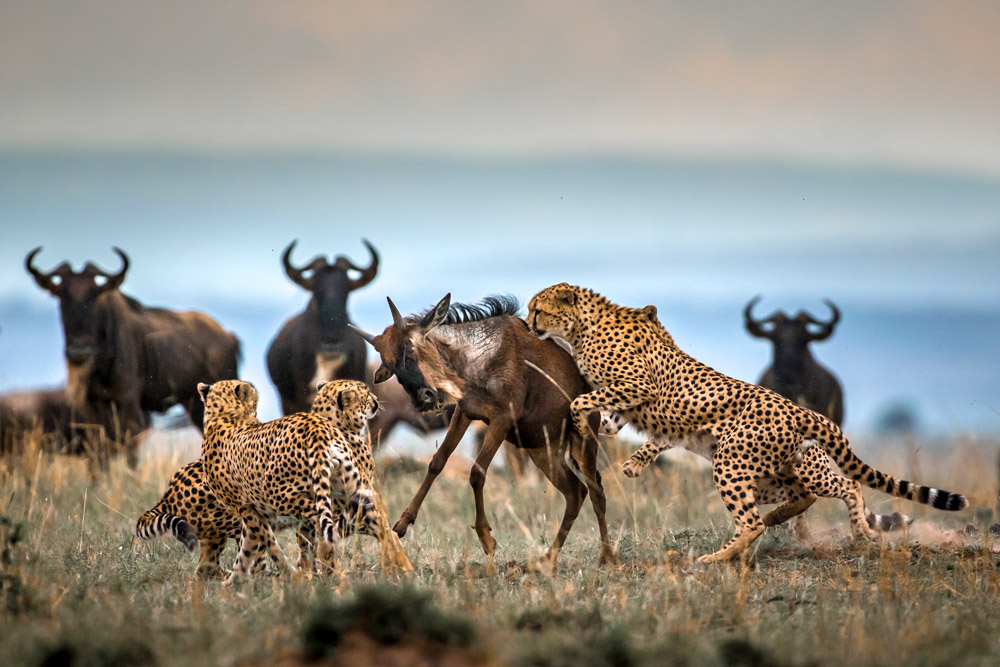
Predator prey experinces during the great Migration in Serengeti np
April
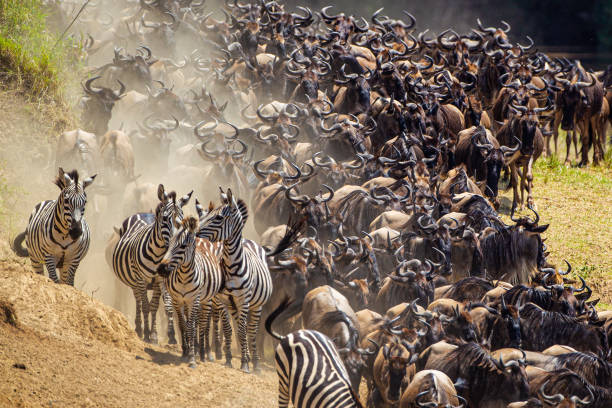
The great wildebeest migration in this Tanzania National Park continues as the wildebeests move towards the central region of the Serengeti. So they as well make temporary settlements around the Moru Kopjes. Here, the grasses are short which the wildebeests in Tanzania normally feed on. Another reason as they move with the zebras is because they don’t eat the tall grasses. So, the zebras eat the tall grasses and the short grasses remain for the wildebeests. During this Serengeti migration season, some of the herds extend towards the Seronera valley. So these dispersed settlements, help them cover large grazing areas hence reduced competition for food.
May and June
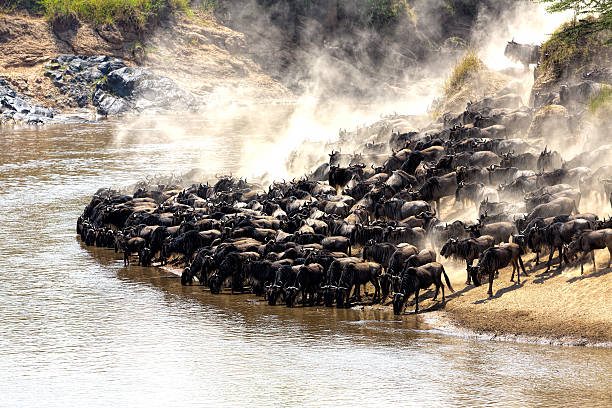
By the end of May, the great wildebeest migration in Serengeti continues westwards towards the Western corridor. Additionally, the wildebeests settle around the Grumeti reserve. By the beginning of June during the Serengeti migration safari, the wildebeests are now crossing through the Grumeti River. So around this Serengeti great migration timing, it is good to witness the predator-prey interactions. Here,wildebeests herds face a threat of the Nile crocodiles in the river and the cheetahs and lions on land. Most of the visit Serengeti during this time because it is optimal for game viewing and being a dry season, game, drive experiences and nature photography are ideal.
July
By June, most of the herds will have crossed via the Grumeti River and will now be grazing around the Kogatende airstrip. By the end of July, they will be heading north towards the Mara River in the Serengeti Mara Area. This marks the end of the animal migration safari in Serengeti in that cycle and starts the Masai Mara migration in the Kenya migration season from July to October.
Map of the great wildebeest migration in Serengeti
Serengeti Masai Mara Safari provides detailed wildebeest migration map resources below for the great wildebeest migration in Serengeti Africa.
What are the best months for witnessing the Serengeti migration Safari in Africa
For the river crossings:
The best time to go to the Serengeti for the big migration in Africa’s Tanzania characterised by river crossings is from October to December. During that Serengeti migration time, large herds of animals are seen crossing over from the Masai Mara National Reserve to Serengeti np. The other river crossings are from mid-July to late September. Duting these migration dates, Serengeti migration animals are crossing over from the Northern plains of Serengeti. They head to the River Mara region of Masai Mara Kenya.
For the wildebeests calving season.
The best time of year to go to serengeti to witness the wildebeests giving life to their new born is between January to March. This wildebeests calving happens in the Southern plains of the Serengeti around the Ngorongoro conservation area and the Ndutu region.
Best time for witnessing the predator- wildebeest chases in Serengeti
The Serengeti migration time of year for predator-wildebeest chases is when the wildebeests are calving between February and March. Additionally, this is because the predators are usually on the chase for them during this great migration Tanzania. Also, the periods of river crossings when the wildebeests are crossing from the Maasai mara reserve to Serengeti from October to November. Lastly, the East Africa great migration from the Serengeti NP to Masai Mara from late July to September.
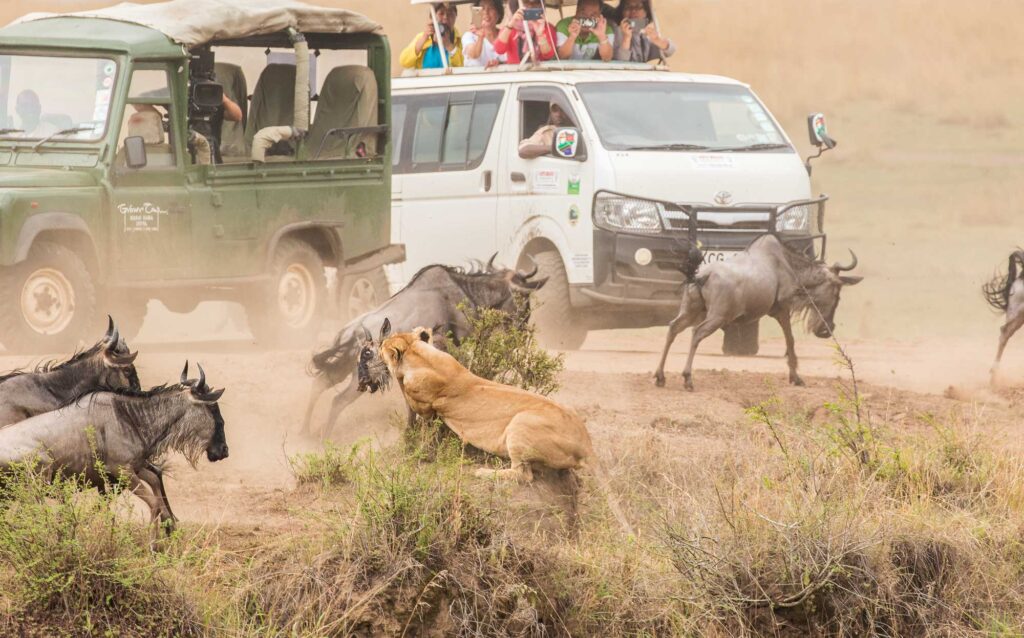
A lion attacking wildebeests in Serengeti Tanzania
Worst time to go for a wildebeest migration Serengeti safari
- April-May (Long Rains)
- Why It’s Tricky: The long rainy season from April to May is the worst time for Serengeti Migration safaris. So this rain makes roads muddy and tough to navigate. Also, the herds are spread out across the central Serengeti, so they’re harder to find. Thick vegetation can hide animals too.
- Should You Go? If you’re okay with rain and want a budget-friendly trip, you can still have fun in places like Seronera. However, it’s not the best for migration fans in the Serengeti.
- How to Plan: Book flexible Tanzania trips and stick to central Serengeti lodges like Dunia Camp. You might score last-minute deals due to lower demand.
- November (Short Rains)
- Why It’s Tricky: The short rains in Tanzania scatter the herds as they head south, making them harder to track. Also, the rain can mess with Serengeti safari game drives too.
- Should You Go? It’s a low season with cheaper rates and fewer people. So, it’s not a bad time for budget travelers who don’t mind missing the big migration moments in Africa’s Serengeti. Focus on resident wildlife or add a side trip to Tarangire for birds.
- How to Plan: Book 2-3 months ahead for Lobo or central Serengeti lodges and keep your wildebeest migration Serengeti itinerary flexible.
- October (Late Dry Season)
- Why October Is Less Ideal: The wildebeest are spread out across the northern Serengeti and Masai Mara in Kenya, and river crossings are less frequent. The landscape’s dry and dusty, so it’s not as pretty.
- Should You Go? It’s still decent for game viewing, especially in the northern Serengeti. Also, there are fewer crowds than in August. It’s a good middle-ground option.
- How to Plan: Book 3-5 months ahead for northern camps like Kichakani and aim for Kogatende to catch any late crossings.

Conservation Efforts Supporting the Wildebeest Migration in Serengeti
The Serengeti wildebeest migration depends on the protection of a much larger ecosystem than the national park alone. The wildebeest migration spans some 1,000 km through the greater Serengeti-Mara ecosystem of Tanzania and Kenya. So, conservation thus focuses on maintaining the connectivity of grazing land, water sources, wildlife corridors, and protected areas around them.
1. Protection of the migration route
Tanzania National Parks (TANAPA) manages Serengeti National Park, while conservation authorities in Kenya manage the Masai Mara side of the ecosystem. The wider conservation landscape also includes areas such as Ngorongoro Conservation Area, Maswa, Grumeti and Ikorongo. Keeping these areas connected allows wildebeest to follow seasonal rainfall and grazing without major artificial barriers.
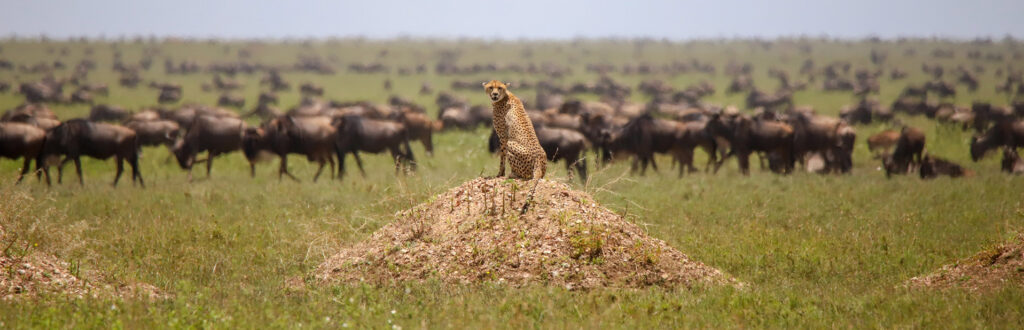
2. Anti-poaching and de-snaring
Wire snares used for illegal bushmeat hunting remain a major threat to wildebeest and other wildlife in the Serengeti. Conservation teams supported by the Frankfurt Zoological Society (FZS), TANAPA and tourism partners conduct patrols and remove snares from high-risk areas.
Since the Serengeti de-snaring program began in 2017, more than 80,000 snares have been removed, according to project reporting, with hundreds of animals released from snares. FZS reported in 2026 that its expanded efforts had removed more than 112,589 snares and released over 1,600 animals alive.
3. Community conservation
Conservation of animals during the great migation in Serengeti also extends beyond park boundaries. The Community Conservation Banks (COCOBAs) program, established in the Serengeti ecosystem in 2009 through FZS and TANAPA, provides savings and small loans for activities such as beekeeping, poultry keeping, and tree planting.
By 2023, the program had reached 125 groups, encompassing 3,223 community members. The approach is intended to provide alternative livelihoods while reducing dependence on activities such as bushmeat hunting of wildebeests, gazelles and more.
4. Scientific research and wildlife monitoring
Long-term research helps conservation managers understand changes in wildlife populations, migration routes, habitat conditions, rainfall and ecosystem health. The Greater Serengeti conservation program brings together researchers and managers to use scientific information when making conservation decisions.
5. Protecting wildlife corridors
The Serengeti wildebeest migration cannot survive if animals are confined to isolated protected areas. Research on wildebeest movement has shown that the animals use both strongly protected areas and surrounding buffer areas. Conservation, therefore, includes protecting corridors, buffer zones and community-managed areas outside the core park.
6. Protecting the ecosystem from major development threats
Maintaining open migration routes in the Serengeti is essential. UNESCO identifies the integrity of the Serengeti ecosystem and the absence of barriers along the migration route as important conservation factors. Habitat conversion, infrastructure development, water scarcity and other changes can disrupt the movement of migratory animals.
Why conservation matters
The Serengeti migration safari is not simply a movement of wildebeest. So, it is an ecological process that supports the Serengeti’s grasslands, predators, and wider food web. Hence, protecting the wildebeest migration in the Serengeti means protecting the animals, their breeding and grazing areas, water sources, corridors, and the communities living around the ecosystem
The Best Places in Serengeti to Witness the great wildebeest Migration from
Depending on the season, the wildebeest migration cycles through Kenya’s Masai Mara and Tanzania’s Serengeti National Park. Here’s a rundown of the best Serengeti safari areas to see the great wildebeest migration.
1. Ndutu Plains & Southern Serengeti (Ngorongoro Conservation Area)
Travel dates: December to March
What’s Cool: It’s crazy during calving season! Every day, some 8,000 wildebeest babies are born, particularly in February. Massive herds are easily spotted in the broad plains of Ndutu, where lions, cheetahs, and hyenas hunt the babies. With its verdant surroundings that are ideal for photography, it resembles a real-life nature documentary.
Why You’ll Love It: The predator action is fierce, and the herds are extremely concentrated. Also, if you’re interested in history, you’re close to places like Olduvai Gorge in Tanzania.
Where to Stay: You may stay right in the thick of things in mobile camps like Olakira, Ubuntu. Also, Serengeti South Camp and these move with the herds. Lodges in the Ngorongoro Conservation Area are an excellent starting point if you’re looking for something more permanent.

2. Central Serengeti (Moru Kopjes & Seronera Valley
Travel dates: April to May
What’s Cool: The herds travel northwest through Seronera and Moru Kopjes when the rains begin. Hence, creating magnificent columns that may extend for miles. You’ll see wildebeest grazing Seronera Valley and Moru Kopjes and gearing up for their big move north. The rocky outcrops are also prime spots for spotting leopards lounging around.
Why You’ll Love It: Seronera’s the heart of the Serengeti, with awesome wildlife year-round (hello, Big Five!). It’s a great spot if you want a mix of migration and other animals in Serengeti NP.
Where to Stay: Check out Dunia Camp or other central Serengeti lodges for a comfy stay with great access.

3. Western Corridor (Grumeti River)
When to Go for the great migration in the western Corridor: June to July
What’s Cool: The wildebeests herds hit the Western Corridor and face their first big challenge. Hence, crossing philosophical the Grumeti River, where crocodiles are waiting for a snack. It’s not as intense as the Mara River, but still thrilling, and its quieter than the northern hotspots of Serengeti.
Why You’ll Love It: You get dramatic river crossings without the big crowds, plus tons of other wildlife like leopards and lions.
Where to Stay: Mila Tented Camp or mobile camps like Nyasi Migrational Camp put you close to the action.

4. Northern Serengeti (Kogatende & Lamai Wedge) & Masai Mara
When to Go for the wildebeest miration safari in Northern Serengeti: July to October (August–September is peak)
What’s Cool: This is the stuff of wildlife documentaries! The herds tackle the Mara River in the northern Serengeti. You will spot the wildebeests dodging crocodiles and steep banks in chaotic, heart-pounding crossings. From August to October, the action spills into the Masai Mara Kenya, where the grasslands are buzzing with predators.
Why You’ll Love It: The Mara River crossings are the migration’s main event. The northern Serengeti is less crowded than the Maasai Mara, so it’s perfect if you want a bit more space. The Lobo area up northeast is great for quieter herd sightings too.
Where to Stay: Kichakani mobile camp or Serengeti Sojourn in the Lobo area are awesome for the northern Serengeti. In the Maasai Mara, try Serian the Original or riverside camps for a luxe vibe during your Serengeti migration safari.

5. See wildebeests in Loliondo & Lobo Area
When to Go to Loliondo & Lobo Area for the great wildebeest migration Serengeti: October to November
What’s Cool: As the short rains start, the herds head south through Loliondo and Lobo, grazing on fresh grass. It’s a quieter time with scattered herds, but you’ll still see plenty of wildlife, like lions and leopards, without the crowds.
Why You’ll Love It: It’s off-the-beaten-path, so you get a more personal Tanzania migration safari experience with stunning scenery.
Where to Stay: Mobile camps or lodges in the Lobo area are your best bet for catching the herds on their way back.

Other Tanzania safari experiences in Serengeti besides the Great wildebeest migration
Below are the alternative Tanzania safari experiences to do other than the Great Wildebeest Migration in Serengeti. So these are the top things to do in Tanzania during your Serengeti migration safari.
- Tour of the Maasai village
Here, you are able to meet with the Maasai people and be exposed to their unique culture and traditions. These include the Maasai traditional wear, cultural dances and their traditional way of housing. Also, design making of art crafts like their handmade necklaces and bangles. These Tanzania cultural tours are add ons to your animal migration in Serengeti national park.
Envision yourself ascending into the sky as you get to see the wild activities beneath you such as the wildebeest migration Serengeti. And also see the lions in Serengeti Tanzanija chasing their prey in an aerial view during your Serengeti balloon safari in Tanzania. You are also engulfed in the beauty of the charismatic boundless landscape of the Serengeti National Park Tanzania.
- Bush/ wilderness meals.
Taste flavorful delicacies with African cuisines on the sides in the middle of the wild and get to enfold oneself into the African way of life. You can have your wilderness meals at the end of your Tanzania wildebeest Migration in Serengeti.
- Sunset watching.
Get to observe the charms that the sun sets down to the landscape of the Serengeti beautifying it to a breathtaking out looking. Also,making your Serengeti safari tour adventure so distinguished and memorable.
How to Prepare for the Great Wildebeest Migration safari in the Serengeti
Serengeti Tanzania Park Rules and Wildlife Etiquette
- Follow the Serengeti national park’s rules for better conservation of the eco system during your Serengeti migration safari in Tanzania.
- If one is driving themselves through the Serengeti, they are not to exceed a speed limit of 50km/hr. Also, don’t go off the marked pathways for driving in the Serengeti Park.
- Unnecessary noise, littering and feeding the animals without permission is not around in Serengeti np. In addition, it doesn’t go hand in hand with wildlife conservation efforts in Serengeti National Park.
- Follow the Serengeti safari guide’s instructions to be on the safe side and keep a distance of at most 7m from the wild animals during your Serengeti migration tour.
What to Pack for a Wildebeest migration Safari in Serengeti Tanzania
Wondering what to bring for your great migration Tanzania safari? Our Serengeti Masai Mara guide below lists the items you should pack for your Serengeti Migration Safari in Tanzanoa
- Water bottle.
- Travel backpack.
- Sunscreen
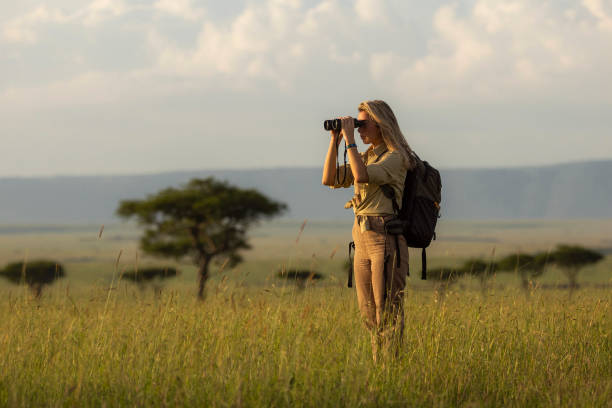
- Binoculars for better sunset watching and seeing wildebeests in Serengeti Tanzania.
- Mosquito repellent to prevent malarial infections.
- Hiking boots to easily navigate through the Serengeti during nature walks.
- Light and heavy clothes because of the volatile weather changes in Serengeti National Park
Expected Costs During Your Great migration wildebeest Migration Serengeti safari
- Serengeti National Park entrance fees;Serengeti Tanzanija has many entrance gates. However, if you want a great wildebeest migration Serengeti safari, take note of these costs which vary with season. Firstly, for the main gate, foreigners (adults) pay 60$-70$ per person for a day. Children pay 20$ but for the East African resident (adults) pay Tshs10, 000 and children pay Tshs2000.
- Guide fees. Guide fees are usually part of your Serengeti migration safari package cost from our Serengeti Masai Mara Team. However, the guide fees per day can range from20$-50$ per day according to the specifics of the traveler.
- Ranger fees. The ranger fees are also usually included in the Serengeti safari tour packages. However, payment for them is made in Tanzanian local currency and will all be handled by our team during your great wildebeest migration safari in Serengeti.
Where to Stay for The Great Wildebeest Migration in Serengeti
Wondering where to stay for the Serengeti great wildebeest migration in Tanzania. Accommodations for during your Great Migration in Tanzania are available for all classes ranging from budget to luxury Serengeti lodges.
Serengeti Lodges: Budget and Luxury Options
| Category | Lodge Name | Price (USD) |
|---|---|---|
| Budget | Africa Safari Serengeti Ikoma Camping | $48 |
| Africa Safari Serengeti Kusini | $105 | |
| Africa Safari Maasai Boma | $139 | |
| Osero Serengeti Luxury Tented Camp | $142 | |
| Seronera Wildlife Lodge | $158 | |
| Luxury | Escarpment Serengeti Luxury Camp | $441 |
| Four Seasons Safari Lodge Serengeti | $750 | |
| Serengeti Luxury Retreat | $613 | |
| Serengeti Sametu Camp | $504 | |
| Serengeti Woodlands Camp | $450 |
A Few Extra Tips to Make Your Great wildebeest migration Serengeti safari Epic
- Book Early with Serengeti Masai Mara safari company: The best affordable and luxury camps and lodges in Serengeti get snapped up fast. Especially for July–September and December–March during the peak great wildebeest migration season in Serengeti. So, plan 6-8 months ahead for peak times for a perfect great migration Serengeti safari in Tanzania.
- Stay a While: Give yourself at least 4–7 days to boost your chances of seeing river crossings or calving. The herds don’t follow a strict schedule!
- Go with Pros: Pick a safari operator like Serengeti Masai Mara, Kilimanjaro Rwenzori, Tanzania National Parks, or Goar Africa Safari Tours with expert guides who track the herds in real-time. Also, can book with Car Rentals 4×4 company for bespoke self drive safaris for the great migration in Tanzania. Mobile camps that move with the migration are your best bet.
- Mix It Up: Add Ngorongoro Crater, Tarangire and more to your trip for a mix of wildlife and landscapes.
- Pack Right: Bring binoculars, a good camera, and neutral-colored clothes. Be ready for hot days, cool nights, and maybe some rain.
- Tread Lightly: Choose eco-friendly camps in Tanzania to support conservation and keep the Serengeti pristine for future adventurers.
Affordable Luxury Great Wildebeest Migration Serengeti Safari Packages in Tanzania
Choose from custom Serengeti migration safari packages that match your travel style. Do you want budget, mid-range, or high end or luxury Serengeti animal migration safari in Tanzania? Customise your great wildebeest migration Tanzania safari with Serengeti Masai Mara Safari.
Below are the popular great wildebeest migration safari packages for Serengeti National Park.
Plan your Serengeti animal migration in Tanzania Today!
Read More about the big Migration in Africa
Read More about the Great Migration in Masai Mara
Know More about the best time to see migration in Africa